Vibration reports that show their working.
The route is done and the files are on your laptop. Tested, deterministic code computes every number — ISO 20816-3 severity, bearing fault frequencies from the bearing's own geometry, a confidence grade with the evidence it rests on. A language model drafts the prose and nothing else. You review and sign.
Access is by invite code today. Ask for one at jk@khaingsinternational.com.
What it does
-
Reads your export
Spectrum or raw waveform: CSV, XLSX, UFF/UNV, WAV, .MAT, TXT/DAT/ASC, up to 25 MB per file. WAV, UFF and MAT have their FFT computed here — you do not have to export a spectrum first.
-
Up to three channels
Radial-horizontal, radial-vertical and axial upload together and merge into one reading, so the checks that tell misalignment from imbalance can actually run. Those two look alike on one channel and different across three.
-
Commits, or says why not
Every finding is either committed — with a severity and a confidence grade — or held back as a possibility. When it is held back, the report names the one measurement that would settle it. Nothing is a guess dressed up as a diagnosis.
-
Checks itself
Every claim in the draft is verified against the computed result before the report issues. If drafting is unavailable the deterministic report still ships, with a visible note — a job never fails silently into prose.
-
Keeps nothing
Your raw file is deleted as soon as it has been read, and the report is removed 60 minutes after it is produced. No account is required to run one.
-
Loads nothing from anyone else
Fonts are self-hosted, there is no analytics, no tag manager and no CDN. No request for this page reaches a third party. See privacy.
Benchmarked in public, misses included
Scored against three public laboratory corpora, a set of real-world field bearings and a 2 MW wind turbine's high-speed shaft. These are the measured numbers, and the failures are named because a diagnostic tool that hides them cannot be checked.
| Corpus | Result | What it means |
|---|---|---|
| CWRU bearings | 20 / 24 | Correct inner/outer-race calls. 0 / 4 false bearing calls on healthy files. The four misses are one fault condition — a defect tone quieter than the noise it must be separated from. |
| MFPT rig | 17 / 17 | Correct inner/outer-race calls, with no false positives on the healthy baselines. |
| Real-world field bearings | 1 / 3 | Two failures, reported as failures. On two files real race content never gets picked up, so the report reads as a clean bill on a known-faulted machine. The fix was attempted and rejected: every variant that surfaces it also invents faults on healthy machines. |
| MAFAULDA healthy files | 6 / 10 | Clean — no fault of any kind reported. Was 1 / 10 before three guards were added. |
Known limitation. Committed imbalance needs phase verification, so imbalance on acceleration-only data is reported as a possibility rather than as a diagnosis. Bearing identification on the wind-turbine timeline is blocked on a data gap, not a code gap — the roller count of that bearing is not obtainable from a citable source, and inventing it would produce a confident meaningless answer.
Read the full validation record, including the literature cross-references and the root cause of every miss.
The report is the product
A survey report you could hand to a plant manager: the verdict up front, the evidence plotted from the data, the computed frequencies it was matched against, and a signature block. Marked DRAFT until a qualified analyst signs it.
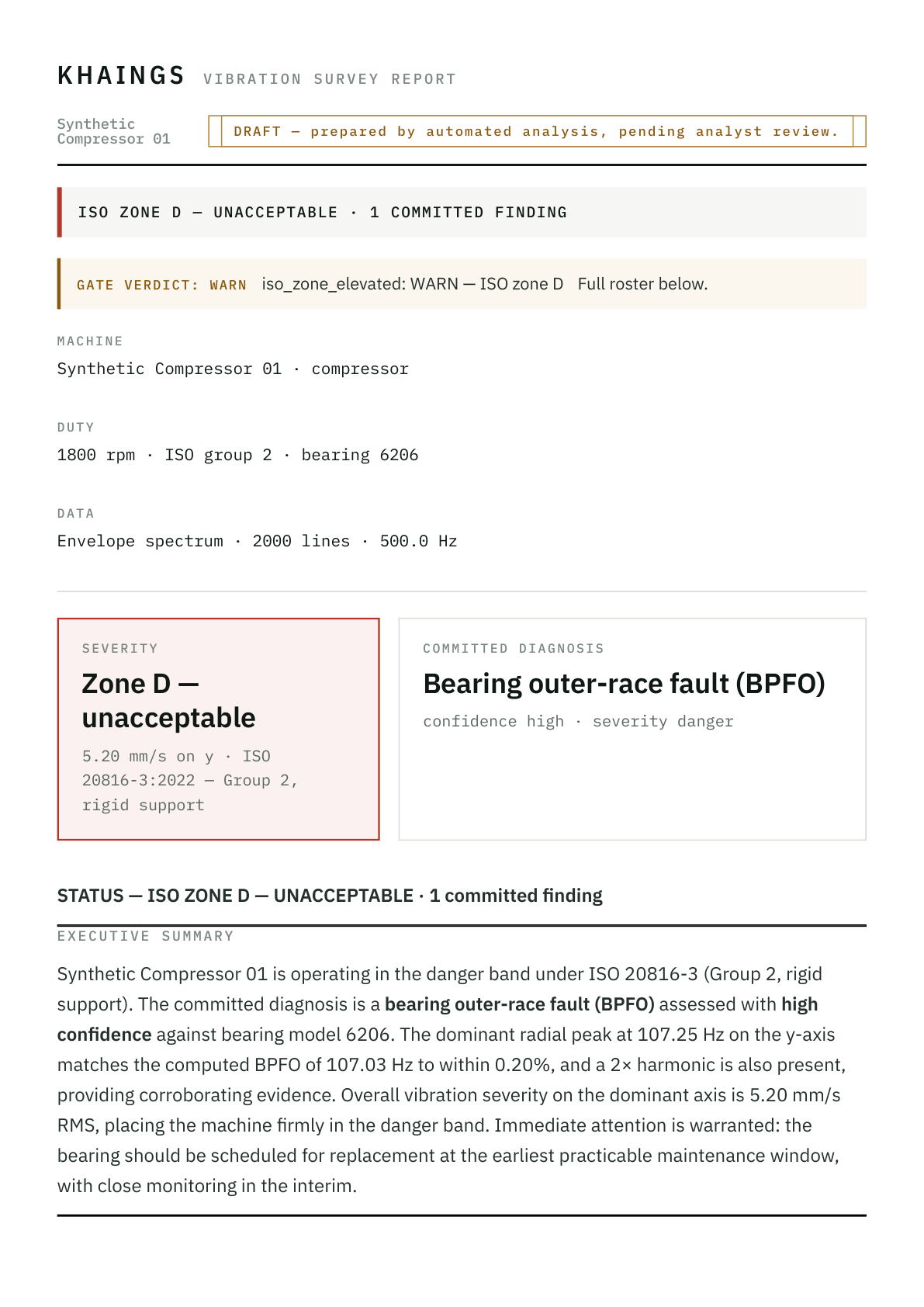
A synthetic compressor with a seeded outer-race fault, drafted by the same path your own file takes. Seed-generated on purpose, so the shop-window document cannot be mistaken for a reading someone actually took — real-data results live on the validation record instead.
Start
No account. Your raw file is deleted as soon as it has been read. You need an invite code — ask for one at jk@khaingsinternational.com.